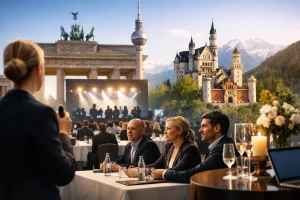
A boardroom in Frankfurt may be filled with senior leaders while colleagues in Chicago, Singapore, and London join on screen. The agenda is shared, but the experience is not automatically equal. Can DMCs support hybrid meetings in a way that gives every participant real access, clear communication, and a professional impression? Yes — provided the DMC is involved early enough to coordinate far more than the destination program.
A hybrid meeting is not simply an in-person event with a video link. It is two connected experiences, each with its own technical, logistical, and hospitality requirements. For international organizations meeting in Germany, a capable destination management company can bring these moving parts together with the precision that complex corporate events demand.
Can DMCs Support Hybrid Meetings Beyond Logistics?
The short answer is yes. A DMC is often best known for venue sourcing, hotel programs, transfers, dining, and local experiences. Those services remain central. In a hybrid format, however, they must be planned around the production and participation model from the beginning.
The right venue is not just one with an elegant plenary room and convenient guest rooms. It needs sufficient bandwidth, dependable redundancy, appropriate rigging or production access, strong acoustics, controlled lighting, and spaces that allow presenters to move naturally on camera. A room that feels impressive to 300 delegates can still create a poor broadcast if the stage, screens, sightlines, and sound have not been designed for remote viewers.
This is where a local DMC adds practical value. With destination knowledge and established supplier relationships, the team can assess whether a Berlin industrial venue, a Munich hotel ballroom, or a waterfront location in Hamburg is genuinely suitable for the intended format. The recommendation should account for the audience, the content, the available budget, and the level of production required — not simply the venue’s visual appeal.
A DMC also provides a single point of local coordination. That reduces the risk of the event planner managing separate conversations with hotels, venues, transportation providers, catering teams, audiovisual specialists, interpreters, and activity partners in different time zones. Hybrid meetings have more dependencies than traditional meetings. Clear ownership matters.
Hybrid Success Starts With Meeting Design
The most common hybrid error is to treat remote attendees as passive observers. They can see the stage, but they cannot ask a question easily, join a discussion, or feel part of the room. The event may technically function while failing as a meeting.
Before any venue or technology is confirmed, organizers should define what remote participants need to do. Are they watching leadership presentations? Joining workshops? Voting on decisions? Networking with peers? Accessing confidential content? Each answer changes the event design.
For a leadership town hall, the priority may be broadcast quality, speaker preparation, captioning, moderated Q&A, and audience polling. For a sales conference or training program, smaller digital breakout rooms, dedicated facilitators, and carefully timed interaction may matter more. A hybrid incentive element requires another approach entirely, since the atmosphere of a chef-led dinner in Düsseldorf or a private museum event in Cologne does not transfer naturally to a screen.
A DMC cannot replace an organization’s internal content owners or a specialized broadcast producer. It can, however, ensure the local delivery supports their goals. That may include shaping the run of show around time zones, reserving quiet backstage areas for speakers, coordinating interpreter cabins, arranging branded set elements, and building breaks that serve both the room and the remote agenda.
Venue and Technology Must Be Planned Together
Technology is only one component of a hybrid meeting, but it is the component attendees notice first when it fails. Audio deserves special attention. Remote guests will often tolerate an imperfect camera angle; they will not remain engaged if they cannot hear speakers, panelists, or questions from the room.
An experienced DMC helps evaluate the operational details that are easy to overlook during a virtual site inspection. Where will cameras be positioned? Can cables be installed safely without compromising guest flow? Is there a dedicated technical control area? What internet connection is guaranteed rather than merely advertised? Is a backup connection available? Can the room be darkened for screens while remaining comfortable for the live audience?
The production level should fit the meeting’s purpose. A smaller executive workshop may need a polished but discreet setup with one or two cameras, dedicated microphones, and a secure meeting platform. A global product launch may require a studio-style stage, multiple camera angles, live graphics, remote speaker management, simultaneous interpretation, and rehearsal time for every presenter.
More technology is not always better. Overbuilding a simple meeting can consume budget that would be better spent on skilled technical crew, reliable connectivity, or a stronger attendee experience. Conversely, cutting the production budget on a high-visibility global meeting can damage the credibility of the entire program. A consultative DMC helps clients make that distinction before contracts are signed.
The In-Person Experience Still Carries Weight
Hybrid does not reduce the importance of hospitality. In many cases, it raises expectations for the delegates who have traveled to attend. They should not feel as though they are sitting in a television studio all day, waiting for the next broadcast segment.
The destination program should create moments that reward presence. This may be a gala dinner in a venue that will take guests’ breath away, an intimate tasting with a regional producer, a private cultural visit, or a team activity designed around the group’s objectives. Germany offers exceptional possibilities, from contemporary architecture and automotive heritage to vineyards, lakeside settings, and historic city centers.
Yet these experiences must work with the hybrid schedule. A late evening program in Berlin may exclude remote colleagues in Asia. A long off-site activity may leave no time for a digital workshop. The answer is not to make every agenda item available to everyone. It is to be deliberate about which moments are shared and which are designed exclusively for those on site.
For example, a company could livestream its opening keynote and awards presentation, then offer a regional culinary program for attendees in Germany. Remote colleagues might receive a separate hosted session, a local delivery, or a facilitated networking experience aligned with their time zone. Equal does not always mean identical. It means each audience receives a considered experience rather than an afterthought.
Attendee Management Requires Two Service Models
Hybrid meetings place distinct demands on registration and communication. On-site guests need travel guidance, hotel details, transfer information, dietary collection, local contact numbers, and clear arrival instructions. Remote participants need platform access, technical guidance, session times in their local zone, privacy information, and an obvious route to support if they cannot log in.
Both groups benefit from concise, consistent communication. A DMC can manage the local attendee journey while working alongside the client’s event platform and registration teams. The goal is to prevent gaps, such as an executive receiving a beautiful hotel confirmation but no information about how to join a mandatory pre-event virtual briefing.
On event days, the support structure should be equally clear. The venue team handles physical guest flow. The technical team manages the broadcast and platform. Moderators or digital hosts monitor questions and engagement. The DMC oversees the local operations, supplier timing, hospitality details, and contingency response. When responsibilities are defined in advance, problems can be resolved without visible disruption.
What a DMC Should Not Promise
A credible DMC will be clear about the limits of its role. Not every destination management company has in-house broadcast capability, cybersecurity expertise, or a proprietary event platform. Those capabilities may be supplied by specialist partners, and that is often the right approach.
What matters is the ability to assemble, brief, and manage the right local team. The DMC should understand enough about hybrid delivery to ask the right questions, identify risks, and make sure venue, hospitality, production, and transportation decisions support one integrated plan.
Clients should also be realistic about budget and lead time. Hybrid formats can require additional technical rehearsals, dedicated crew, platform licensing, content adaptation, and staffing for remote engagement. Savings from reduced travel do not automatically make a hybrid meeting less expensive. The value lies in broader reach, more flexible attendance, and a program that can connect teams who would otherwise be absent.
A Strong Local Partner Makes the Format Feel Intentional
The best hybrid meetings do not feel like a compromise between a live event and a virtual call. They feel designed for the people attending in each mode. That requires disciplined planning, honest technical assessment, and destination expertise that extends beyond booking a room.
For corporate meetings in Germany, My German DMC can coordinate high-class services, exceptional venues, local hospitality, and the operational detail required to support a hybrid program with confidence. Contact our team early in the planning process, and the format can become a considered advantage rather than a last-minute technical addition.