A river cruise in Cologne, a private automotive challenge in Stuttgart, a vineyard program near Frankfurt, or a winter incentive in Bavaria — team building activities Germany offers can feel exceptional when they are designed around the right business goal. For corporate groups, the difference is rarely the activity itself. It is the fit between destination, group profile, timing, and execution.
That is where many programs either become memorable or merely fill an afternoon. A senior leadership team arriving for a strategy meeting needs a very different format than a sales incentive group, a post-merger team, or an international conference audience with limited time. In Germany, the standard can be remarkably high, but so are expectations around punctuality, logistics, and service quality. A successful program has to deliver energy and connection without creating operational friction.
What makes team building activities in Germany work
Germany is especially well suited to corporate team building because it combines strong infrastructure with very different regional identities. Berlin brings creativity and edge. Munich adds polish and premium hospitality. Hamburg works beautifully for maritime and waterfront experiences. The Rhine and Moselle regions create a more relaxed incentive atmosphere, while cities such as Frankfurt, Stuttgart, and Düsseldorf support business-first agendas with efficient access and excellent event services.
The best team building activities in Germany are not chosen because they are fashionable. They are chosen because they support a purpose. Sometimes that purpose is straightforward — reward, motivation, and morale. Sometimes it is more strategic, such as strengthening communication across markets, integrating new leadership, or giving international delegates a more personal connection to the destination.
There is also a practical advantage to planning these programs in Germany. Travel times are manageable, suppliers are generally structured, and many venues are accustomed to international corporate groups. That opens the door to ambitious concepts without sacrificing reliability. For event planners and procurement teams, that balance matters.
Choosing the right format for your group
Not every team wants to build a raft, solve a puzzle, or compete in a high-energy challenge. A well-designed corporate program starts by asking what kind of interaction is actually useful.
If your group is meeting after a day of presentations, the ideal format may be social and lightly structured rather than intensely competitive. A culinary experience, brewery program, private market challenge, or guided cultural task can encourage conversation without exhausting attendees. These work particularly well for mixed-age groups, international participants, and clients or partners who need a more polished setting.
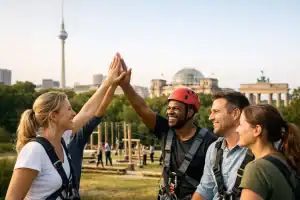
For internal teams that already know one another, more active formats often perform better. Urban rally concepts, driving-related challenges, outdoor problem-solving, or collaborative creative workshops can introduce healthy momentum. The key is pacing. Too little structure and people disengage. Too much structure and it starts to feel like mandatory entertainment.
Leadership groups usually need something else entirely. They respond better to curated experiences that create reflection, exclusivity, and high-value interaction. Think private access, distinctive venues, and elegant hosting rather than loud competition. In these cases, the team-building outcome comes from shared experience and quality time, not from novelty alone.
City-by-city ideas with real corporate value
Berlin is a strong choice for companies that want something contemporary, energetic, and slightly unconventional. The city supports everything from innovation-themed challenges and street art workshops to historical quests and exclusive evening receptions in striking venues. It is ideal for groups that appreciate personality and creative contrast, though the program needs careful curation to stay premium.
Munich is one of the most reliable destinations for upscale corporate experiences. Team building here can lean into Bavarian culture without becoming clichéd. Private culinary workshops, alpine-style incentive elements, lake excursions, and refined beer experiences can all be executed at a high level. Munich is particularly effective when the event needs to feel both warm and well managed.
Hamburg offers a distinctive maritime atmosphere that works well for executive groups and international delegates. Harbor-based activities, sailing formats, warehouse district explorations, and waterfront dinners create a setting that feels elevated from the start. It is a city that combines strong logistics with character, which is often exactly what B2B planners need.
Frankfurt makes sense when attendees are arriving from multiple countries and the schedule is tight. It may not be the first city associated with team building, but that is often an advantage. Short transfer times, strong hotel inventory, and nearby wine regions allow planners to pair efficiency with experience. For conference groups or financial-sector teams, that practicality is a real asset.
Stuttgart is especially compelling for automotive, engineering, and innovation-driven companies. Programs can tap into precision, mobility, and craftsmanship in ways that feel relevant rather than generic. This is where local expertise makes a visible difference, because access, timing, and venue selection shape the quality of the experience.
The trade-offs planners should consider
The most common planning mistake is choosing an activity before defining the group dynamic. What looks exciting in a proposal can be ineffective on the ground if attendees are jet-lagged, dressed for a meeting, or simply not inclined toward public competition.
Seasonality matters too. Germany works year-round, but the right concept changes significantly by season. Summer opens the door to river programs, vineyard events, lakeside experiences, and open-air formats. Winter can be remarkable for Christmas-market themes, private seasonal hospitality, alpine extensions, and elegant indoor experiences. The trade-off is daylight, weather sensitivity, and transport timing.
Group size also changes everything. A boutique executive team can access intimate venues and highly tailored formats. A 300-person conference delegation needs scalable logistics, clear rotations, and a program that feels cohesive even when delivered in multiple streams. Both can be excellent. They simply require very different design.
Then there is the question of cultural fit. International groups may have different expectations around humor, competition, food, alcohol, and personal interaction. Germany offers tremendous variety, but a format that lands perfectly with one audience may feel awkward with another. Thoughtful planning avoids that mismatch.
Why premium execution matters as much as the idea
In the corporate space, team building is rarely judged only by participant enjoyment. It is judged by how effortlessly the program runs. Did the buses arrive on time? Were dietary requirements handled correctly? Was the tone appropriate for the brand? Did the activity support the wider meeting agenda? Did the evening still feel high-class?
That is why execution has to be built into the concept from the start. Venue access, weather backups, multilingual facilitation, registration flow, transfer management, and timing against plenary sessions all influence the final impression. A simple concept with flawless delivery usually outperforms a spectacular concept with weak logistics.
This is particularly true in Germany, where precision is part of the expectation. International clients often choose the destination because they want confidence as much as creativity. They want venues that will take your breath away, but they also want a partner who can manage suppliers, protect timing, and keep standards consistently high.
For that reason, bespoke design is usually the better investment than an off-the-shelf package. It allows the program to reflect the company culture, destination, event objectives, and attendee profile instead of forcing the group into a generic format. For many planners, that customized approach is where the real value begins.
Planning team building activities Germany visitors will actually remember
The strongest programs usually connect three elements: a destination with character, an activity with purpose, and delivery that feels effortless. When those align, team building becomes more than an add-on. It supports the meeting, strengthens relationships, and gives people a clear memory of the destination.
For international companies and agencies, Germany offers an excellent platform for that kind of result. It is accessible, diverse, and capable of hosting everything from compact executive gatherings to large-scale incentive groups with impressive consistency. With the right local structure in place, the experience can feel polished from the first arrival to the final farewell.
If you are planning a corporate event and want more than a standard social program, it is worth treating team building as part of the event strategy rather than a side activity. That is where the best outcomes happen — in experiences designed with intention, delivered with precision, and remembered long after the agenda is over.