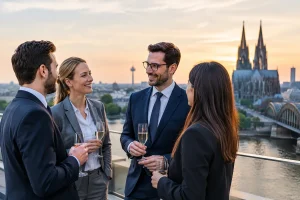
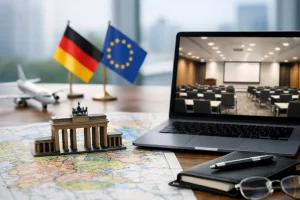
A board meeting in Frankfurt, a gala dinner in a Berlin landmark, and a team activity in the Bavarian Alps can look effortless to attendees. Behind that experience sits a detailed operational plan: contracts, transfers, rooming lists, dietary requirements, venue access, timing, suppliers, and contingency planning. So, what is a DMC in Germany? It is the local partner that brings those moving parts together and takes responsibility for delivering a well-managed program on the ground.
For international companies and agencies, a destination management company is more than a source for hotels or sightseeing. A capable German DMC combines destination expertise with project management, supplier relationships, and high-class hospitality to create corporate events that feel distinctive while running with precision.
What Is a DMC in Germany?
DMC stands for destination management company. In Germany, a DMC is an incoming specialist that plans, coordinates, and operates meetings, incentives, conferences, conventions, corporate group travel, and curated experiences for clients coming into the country.
The DMC acts as the client’s local extension. Rather than asking an overseas event team to negotiate separately with a hotel in Munich, a transportation provider in Hamburg, a venue in Cologne, and a guide in Dresden, the client works with one experienced partner. That partner translates the event brief into a practical, fully coordinated program.
Germany rewards careful planning. Its cities are exceptionally well connected, its event infrastructure is strong, and its venues range from contemporary convention centers to historic castles, industrial landmarks, vineyards, and cultural institutions. Yet each destination has its own supplier landscape, regulations, seasonal pressures, access limitations, and event rhythm. A local DMC knows what is realistic, what is exceptional, and what needs to be secured well in advance.
What a German DMC Actually Does
A full-service DMC begins with the purpose of the program, not a standard package. Is the company bringing senior leaders together for strategic decisions? Rewarding top performers? Launching a product? Hosting customers during a trade show? The answer shapes every recommendation, from the city and hotel category to the arrival schedule and evening experience.
The work often starts with destination and venue scouting. A DMC assesses capacity, accessibility, technical requirements, guest profile, brand fit, and budget before presenting options. The right choice may be a five-star hotel with integrated meeting space for an executive group, or it may be a private museum, a restored factory, or a waterside venue that will take guests’ breath away. A strong recommendation also accounts for practical details, including loading access, security, event curfews, nearby hotels, and coach routing.
Hotel sourcing is equally strategic. For a multi-day conference, proximity between the hotel and meeting venue can protect the agenda and improve the guest experience. For an incentive program, a standout property may be worth a longer transfer if it strengthens the reward value of the trip. A DMC compares more than rates. It evaluates service standards, room inventory, contract conditions, meeting flow, VIP handling, and the ability to support last-minute changes.
On-site logistics form the operational core. This can include airport welcomes, private transfers, coach schedules, rail coordination, delegate registration, staffing, signage, luggage handling, and real-time communication with suppliers. For a group of 20, these arrangements may be straightforward. For 500 delegates arriving on different flights, attending breakout sessions across multiple rooms, and departing in waves, disciplined coordination becomes essential.
A DMC also designs the moments that give a business event a sense of place. That may mean a private after-hours museum visit in Berlin, a chef-led culinary experience in Hamburg, a wine program along the Rhine, or a team challenge in the forests outside Munich. The goal is not to fill an agenda with tourist activities. It is to create experiences that fit the company culture, audience energy, and commercial purpose of the event.
Why Local Knowledge Matters in Germany
Germany is not one uniform event destination. Berlin brings creative energy, landmark architecture, and a global business scene. Frankfurt offers outstanding air access and financial-sector infrastructure. Munich is a natural choice for premium incentives, technology events, and Alpine extensions. Düsseldorf, Cologne, Hamburg, Stuttgart, and Dresden each offer compelling strengths depending on the program.
Choosing between these cities requires more than looking at a map. A DMC understands when a major trade fair will tighten hotel availability, which neighborhoods are best suited to a particular delegate profile, where traffic can affect a transfer plan, and which venues can accommodate a complex production schedule. This knowledge protects both budget and attendee experience.
Local relationships matter as well. Long-standing supplier connections can improve response times, support more productive negotiations, and provide access to distinctive opportunities that may not appear in a generic venue search. They do not eliminate constraints, especially during peak dates, but they help a DMC resolve issues quickly and offer credible alternatives when the preferred option is unavailable.
There is also a cultural benefit. International groups appreciate a program that feels authentically German without relying on clichés. A knowledgeable DMC can incorporate regional food, architecture, history, and craftsmanship with sophistication. It can also advise on business etiquette, service expectations, timing, and the small details that make guests feel considered rather than processed.
A DMC Compared With Other Event Partners
A DMC is sometimes confused with a travel agency, a professional conference organizer, or an event agency. The distinction matters when assigning responsibility.
A travel agency may focus primarily on flights, hotel reservations, and individual travel arrangements. An event agency may lead creative concepts, brand storytelling, content, stage design, and production. A professional conference organizer often manages the formal structure of an association congress, including scientific programs, speaker coordination, and registration systems.
A DMC may overlap with all three, particularly on complex corporate programs, but its defining strength is destination-based execution. It knows how to make the chosen city or region work for the group. It turns an approved concept into transport plans, venue operations, guest experiences, supplier briefings, and on-site delivery.
For many international planners, the best arrangement is collaborative. The client or lead agency retains strategic and creative ownership, while the German DMC manages local procurement and operations. For others, a full-service DMC can take the lead from the first proposal through final departure. The right model depends on the in-house team’s capacity, local knowledge, program complexity, and desired level of control.
When Should You Hire a DMC in Germany?
A DMC is particularly valuable when an event involves multiple suppliers, several locations, international arrivals, high-profile guests, or a tight program schedule. It is also a sensible choice when the company has selected Germany as a destination but has no local office or trusted supplier network.
The value becomes especially clear in incentive travel. Incentive guests expect more than efficient transfers and a good hotel. They expect a rewarding experience with thoughtful pacing, premium service, and memorable access. At the same time, the program must remain financially controlled and operationally sound. A DMC balances the emotional impact of the experience with the discipline required to execute it.
Even experienced event planners benefit from a local partner during periods of high demand. Large exhibitions, seasonal celebrations, major sporting events, and citywide congresses can affect inventory and pricing dramatically. Early DMC involvement helps identify potential pressure points before they become expensive problems.
How to Choose the Right German DMC
Start by looking for evidence of genuine destination depth. A credible DMC should be able to explain why a city, hotel, or venue fits your brief, as well as where the compromises may be. If every proposal looks identical, the planning is unlikely to be truly bespoke.
Ask how the team manages the full event lifecycle. You need clarity on proposal development, contracting, budget tracking, attendee administration, supplier management, on-site staffing, and emergency procedures. Premium experiences are built on this structure. A beautiful venue alone does not guarantee a successful program.
It is also worth assessing communication style. International teams need fast, clear answers, transparent costs, and a project lead who can challenge an assumption when necessary. The best DMC partners do not simply agree to every request. They offer informed alternatives that protect the program’s quality, timing, and budget.
Finally, consider whether the company can scale to your requirements. A small executive retreat and a large convention call for different resources, but both demand care and accountability. My German DMC approaches each program as a tailored operational assignment, matching local knowledge with meticulous planning from the first brief to the final guest departure.
A well-chosen DMC gives planners the confidence to focus on the business purpose of the event while a local expert handles the destination details. Bring the DMC into the conversation early, share the objectives and non-negotiables clearly, and let the planning begin with the possibilities Germany can deliver.